 backyardly
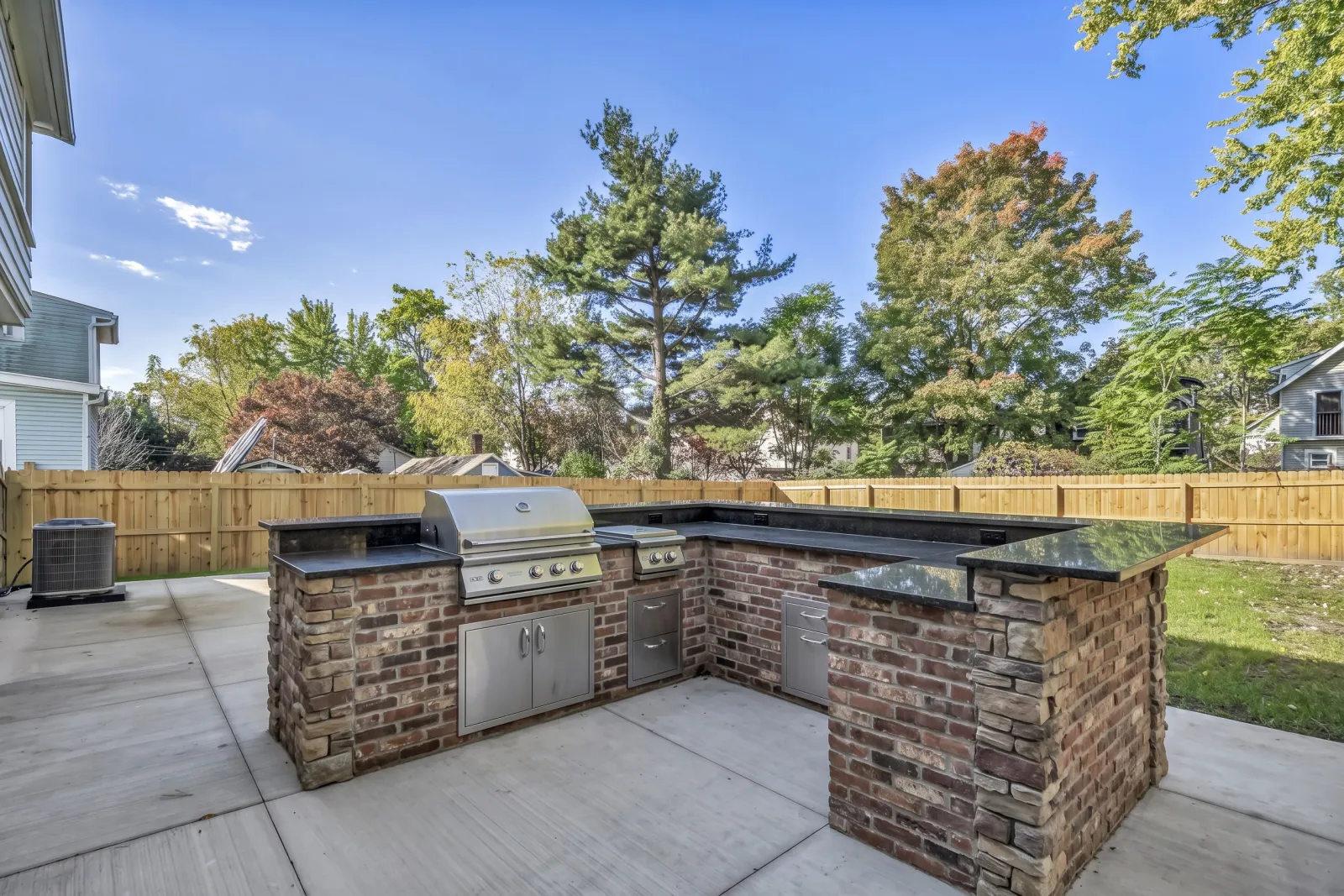
In Florida you can cook outside most of the year, which is why so many Tampa Bay homes already have a grill parked on the lanai. Turning that grill into a real outdoor kitchen comes down to three decisions: the layout, materials that can take sun, humidity, afternoon storms and (near the coast) salt air, and how gas, power and water reach it. This guide covers all three, plus permits and realistic cost tiers, so you can plan before you call anyone.
Layout ideas that work in Florida yards
Start with where the kitchen will sit relative to the house, the cover and the utilities. Every foot of gas line, conduit and drain pipe adds cost, so the shortest runs usually win.
- Straight island. One run of counter with the grill in the middle and landing space on both sides. It fits along the back wall of a house, the edge of a patio or one side of a lanai, and it’s the cheapest to build and plumb. Good for most families who mainly grill.
- L-shape. Two runs at a right angle. The short leg is often a raised bar or a prep and sink station, so the cook isn’t standing with their back to guests. It works well in a corner of a covered patio.
- U-shape. Three runs around the cook. Lots of counter and storage, but it needs a big footprint and usually a bigger cover. It makes sense for people who entertain often and want a fridge, sink and side burner all within reach.
- Bar seating. A raised counter (bar height) on the guest side of a straight or L-shaped island keeps people out of the cooking zone and hides the grill clutter. Leave enough knee space and plan where the stools go when they aren’t in use.
- Under a pergola or lanai roof. Shade makes the kitchen usable in July and protects counters and doors. A solid roof also keeps rain off, but it changes ventilation: ask about the grill maker’s clearance to combustibles and whether you need a vent hood. Our comparison of pergolas, shade sails and screened lanais covers the cover options.
- Inside a pool cage. A kitchen inside a screen enclosure keeps bugs off the food, a real perk in summer. Smoke and grease have to go somewhere, though, so place the grill where screen panels give it airflow and keep it away from the screen frame. See our guide to pool screen enclosures in Florida if you’re planning a cage too.
What to put in it
Most outdoor kitchens grow from the grill out. A sensible order of priorities:
- Built-in grill with landing space on both sides.
- Storage: access doors under the grill and a drawer stack for tools.
- Under-counter fridge, so you aren’t walking back inside for every drink.
- Sink, which needs a water line and a drain (the costly part, see below).
- Side burner, griddle, pizza oven or smoker, if you’ll use them.
- Lighting and outlets, for evening cooking and small appliances.
Fixr says appliances average about $4,000, with most spending $1,500-$7,000, so the appliance list is where the budget moves fastest.
Materials that survive Florida sun, humidity, rain and salt
Stainless steel: 304 vs 316
Most grills and access doors are stainless, but grades differ. The International Molybdenum Association says molybdenum improves stainless steel’s resistance to coastal salt corrosion and treats Type 316 (which contains molybdenum; 304 does not) as the grade for a typical coastal site, roughly 0.12 to 10 miles from a large saltwater body. Two Florida details matter. Severity rises with closeness to salt water, and sheltered surfaces in hot, humid places that rain never rinses are rated more severe. That describes many covered lanai kitchens. Even 316 can show light “tea staining” in severe spots. Near the Gulf or a bay, ask for 316 on doors, drawers and fasteners, and plan to rinse surfaces with fresh water.
Cabinets: polymer, masonry or steel
- Marine-grade polymer (HDPE). Sheet suppliers such as Emco Plastics describe marine-grade HDPE as UV-stabilized, with no moisture absorption, so it won’t rot or swell, and list outdoor cabinetry as a use. Check that the hinges and slides are stainless as well.
- Masonry or concrete block island with stucco, brick or stone veneer. The traditional Florida build: heavy, doesn’t rot and matches a stucco house. Fixr lists face finishes from stucco at $3-$10 per sq ft to natural stone at $25-$50. You’ll still need stainless or polymer doors set into it.
- Stainless cabinets. Clean-looking, but the grade question above applies to the whole box, not just the grill.
Countertops
Fixr’s per-square-foot ranges: granite $70-$140, quartz/quartzite $50-$100, concrete $50-$140, tile $4-$45, stainless $50-$150. Be careful with engineered quartz in full sun. Its color depends on resin, and Caesarstone’s outdoor line uses a different resin made to resist UV fading, which tells you standard indoor slabs aren’t built for it. If you want quartz, ask for a product rated for outdoor use and read its warranty. Granite and concrete are the more common outdoor choices. Ask the fabricator how often to seal them in a humid climate.
Cover, gas, power and water
Cover. Florida summers bring strong sun and frequent afternoon thunderstorms, so a kitchen with no cover gets less use. Fixr lists a pergola at $1,500-$15,000 and general covers at $25-$100 per sq ft. If you’re also building the patio, our paver vs concrete patio guide helps with the slab.
Gas: natural gas vs propane. If the house already has natural gas, a hard line to the island means no tanks to refill, but it’s new gas piping, and Fixr notes cost climbs with distance from the house and any excavation. Propane avoids the trench. Plan a ventilated spot for the tank inside the island, or keep it freestanding next to it.
Power. Fixr estimates about $500 for electrical lines and $50-$100 per fixture, appliance or outlet. The National Electrical Code’s section 210.8 lists outdoor, kitchen and sink receptacles at homes among the locations needing GFCI protection. Your electrician and inspector will apply the edition your county enforces.
Sink and drain. Fixr puts a typical plumbing run at $300-$1,500 (about $500 on average) plus about $300 for the sink. The drain is the hard part. Ask where the gray water goes and how it ties into the house system.
Permits in Tampa Bay
Hillsborough County’s list of work exempt from permits only covers gas items like portable heating appliances and minor part replacements. It doesn’t list gas piping or new circuits, and it says that work not on the list most likely needs a permit. The county also notes that the HB 803 residential permit exemption doesn’t apply when the job includes electrical, plumbing, structural, mechanical or gas work. In practice, a kitchen with a new gas line, circuit or sink should be permitted, and Fixr estimates outdoor kitchen permits at roughly $150-$500 in most municipalities. Pinellas, Pasco and the cities have their own building departments, so call yours with your scope.
What it costs
Fixr’s national average is about $16,000, with most projects $6,000-$30,000, and Angi’s 2026 data lands close at $16,533. Rough tiers:
| Tier | What you get | Typical installed cost |
|---|---|---|
| Grill island | Built-in grill, 1-2 doors or drawers, basic hookup | $3,000-$10,000 |
| Typical kitchen | Several linear feet of counter, grill, small appliances | about $16,000 |
| Full kitchen | Fridge, sink, bar seating, more appliances | $20,000-$50,000 |
Island framing and cabinets run $100-$300 per linear foot, so length is the main dial. See outdoor kitchen cost by city for local ranges.
Hurricane prep for outdoor appliances
The built-in island stays put, but loose items become debris. FLASH advises bringing grills and furniture indoors if they can be stored safely, or anchoring them with cables or chains, and says never to bring propane tanks inside. Before a storm, shut off gas at the tank or valve, close grill lids and doors, put on fitted covers and bring in cushions, tools and portable appliances.
What to ask a contractor before you sign
- What stainless grade are the grill body, doors, drawers and fasteners, and how close to salt water is that grade suitable?
- What is the island built from, and how is it attached to the slab?
- Is the countertop material rated for outdoor use in full sun, and what does its warranty say about outdoor installs?
- Which permits will you pull (building, gas, electrical, plumbing), and are they in the price?
- Where will the gas, power and sink drain run, and is trenching or patio repair included?
- What clearance does the grill need under our roof or inside the screen enclosure?
- Who handles each trade? Check every contractor’s license yourself on the Florida DBPR license search and ask for proof of insurance. Backyardly doesn’t do this for you.
See it in your own yard first
An outdoor kitchen is easier to plan when you can see it in your actual space. An AI concept on a photo of your patio or lanai shows whether an L-shape crowds the pool deck or a bar fits under the roofline. It’s a visual starting point, not a construction plan, but it gives local pros something concrete to quote against.
See it in your own yard first.
Upload a photo of your backyard and get an AI concept of the project in a couple of minutes. Designs are free to try; a clean HD download is $2.99. If you like it, you can publish it for $4.99 to get quotes from up to 4 local pros.
Questions
What is the best outdoor kitchen layout for a Florida backyard?
A straight island against the house or lanai wall is the simplest and cheapest because utilities run the shortest distance. An L-shape adds prep space and a bar side, and a U-shape suits people who cook and entertain a lot. Pick the layout after deciding where the cover, gas and power will come from.
Should I use 304 or 316 stainless steel near the Florida coast?
The International Molybdenum Association treats Type 316 as the baseline grade for typical coastal sites and notes that molybdenum improves resistance to salt corrosion. Close to salt water, or in sheltered spots that rain never rinses, even 316 can tea-stain. Ask what grade the grill, doors and drawers are and plan to rinse them regularly.
Do I need a permit for an outdoor kitchen in Hillsborough County?
Usually, if it includes new gas, electrical or plumbing work. Hillsborough County's list of permit-exempt work only covers things like portable heating appliances and minor repairs, and says anything not on the list most likely needs a permit. Confirm with Development Services before work starts.
How much does an outdoor kitchen cost?
Fixr puts the average at about $16,000, with most projects between $6,000 and $30,000. A basic grill island runs about $3,000-$10,000 per HomeGuide, and a large full kitchen about $20,000-$50,000 per Angi.
What do I do with an outdoor kitchen when a hurricane is coming?
FLASH advises bringing grills and outdoor furniture indoors if they can be stored safely, or anchoring them with cables or chains if not, and never bringing propane tanks inside. Built-in pieces stay put, so close lids, doors and covers and secure anything loose around them.
Sources
- Fixr - Outdoor Kitchen Cost (updated 2025-02-07)
- Angi - How Much Does It Cost to Build an Outdoor Kitchen? [2026 Data]
- HomeGuide - How Much Does an Outdoor Kitchen Cost? (2026)
- International Molybdenum Association (IMOA) - Corrosiveness of Coastal Environments
- Emco Plastics - Marine Grade HDPE (Seaboard)
- Fine Homebuilding - Weatherproof Kitchen Worktop (Caesarstone Outdoor)
- IAEI Magazine - NEC Requirements for GFCI Protection, Section 210.8
- Hillsborough County - Work exempt from permits
- FLASH (Federal Alliance for Safe Homes) - Secure potential yard debris
- Florida DBPR - License search (Verify a Licensee)
Prices are third-party published estimates, not Backyardly quotes, and rules change. Check with your county or city and get written quotes before you decide. Last updated October 29, 2026.